
Do you want students to not only understand how something works but also be able to actually apply it?
Then case-based learning is one of the most effective learning methods. It combines realistic situations, direct theoretical application, and a motivating learning experience.
At Epyc, we strongly believe in this approach because it makes learning concrete and relatable. That's why we applied case-based learning in our didactic concept for the "Clothing Advice" e-learning course for our client VDAB.
Case-based learning is a teaching method in which students learn through realistic, practical situations. Instead of immediately presenting theory, students discover step by step what they need to know to solve a case.
Characteristics of case-based learning:
For organizations, this means a learning experience that sticks and therefore better results.
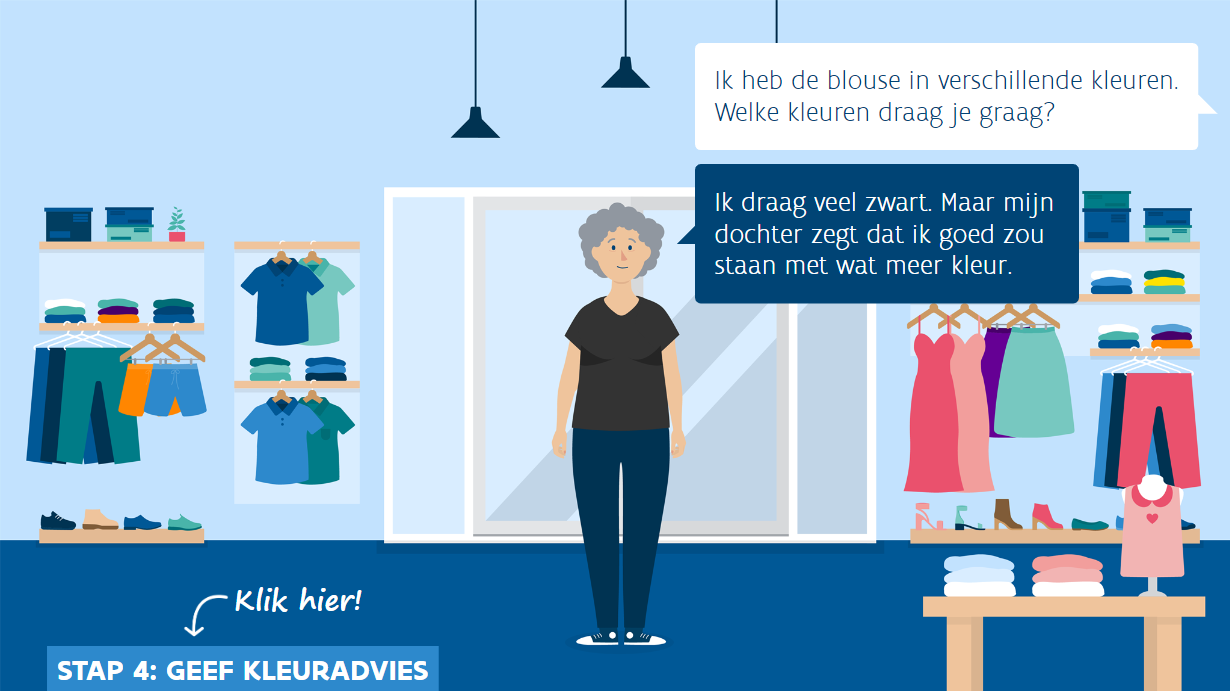
In traditional e-learning, you often have to study theory before you know why you need it. With case-based learning, it's the other way around: the case creates a concrete need for knowledge, which makes students want to explore the theory on their own.
In the Clothing Advice e-learning course, the learner takes on the role of a salesperson in a clothing store. Throughout the modules, different customers enter the store. The learner's task is to help each customer as best as possible with appropriate clothing advice, for example, in the search for jeans that fit the figure type of the first customer.
Only then does the student learn:
The student explores the theory themselves with a concrete goal: to help the customer choose the right jeans as best as possible.
In the Clothing Advice course, students give specific advice after each customer question. They arrive at the right advice through exploratory exercises. That means discovering, learning, doing, receiving feedback... all within the same context. This ensures maximum engagement and retention.
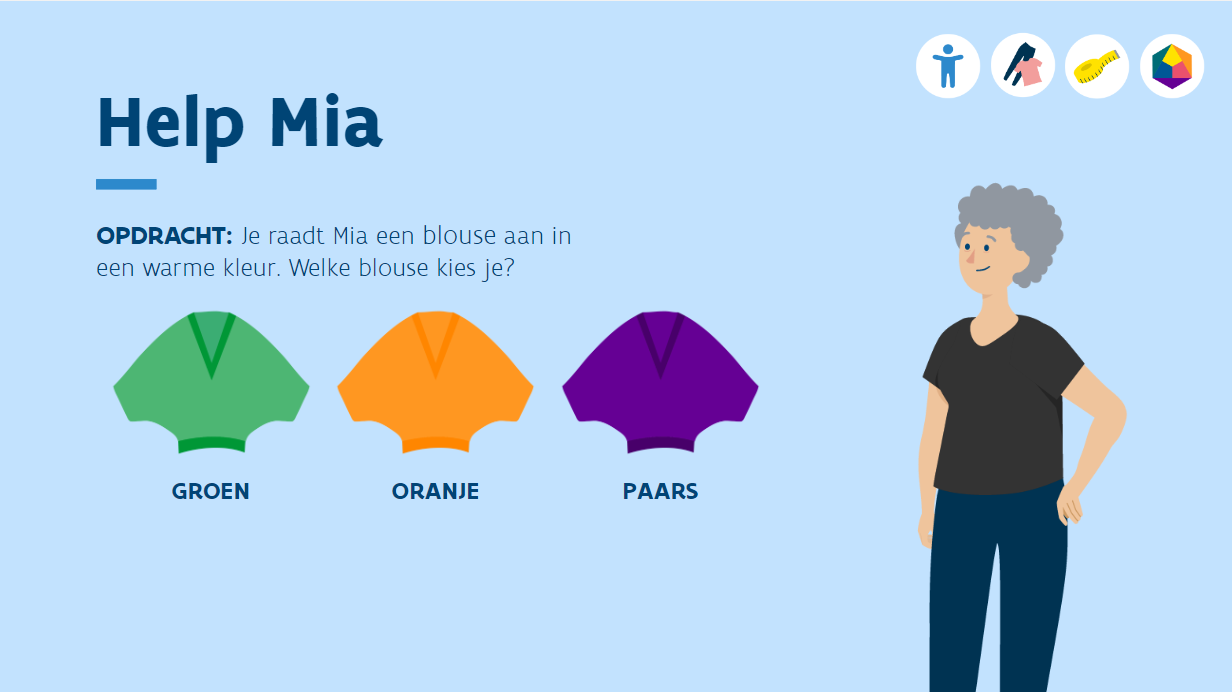

Storytelling makes a big difference. In the Clothing Advice course, everything takes place in a fictional but realistic clothing store. Students help nine different customers, each with their own style, physique, background, and questions.
This ensures that students:
Our case-based approach works with increasing complexity. This keeps the e-learning accessible for beginners, but still challenging enough. The Clothing Advice course consists of nine e-learning modules:
At the end of each module, there is an evaluation, formulated from the customer's perspective. The evaluation is divided by theme. This allows us to show exactly which themes the student has already mastered and which theory the student should pay extra attention to in order to be able to help the next customer even better.


With case-based learning, you limit theory to what is necessary for a specific case. The rest remains accessible for reference.
In our Clothing Advice e-learning course, students can view the complete theory for each theme (body types, clothing items, sizes, and colors) at any time via four icons. This allows students to maintain their autonomy: they decide for themselves when they need additional information.
Case-based learning provides a learning pathway that:
As an organization, you will find that employees are ready to work more quickly and perform their tasks with greater confidence.
We are happy to help you develop a learning method that perfectly suits your target group and learning objectives.
With case-based learning, we create e-learning courses that:
Let us hear from you! We would love to build your next learning experience.

E-learning heeft soms een imagoprobleem.
Vraag aan een gemiddelde werknemer wat hij denkt van online opleidingen en de kans bestaat dat je woorden krijgt zoals “verplicht”, “saai” of “ik heb gewoon op volgende geklikt tot het gedaan was”.
Niet meteen de droomreactie van een L&D-manager.
Nochtans ligt dat meestal niet aan het idee van e-learning zelf, maar aan de manier waarop veel online opleidingen worden opgebouwd. Te lang. Te theoretisch. Te weinig relevant voor de praktijk. Of gewoon gemaakt omdat “het nu eenmaal verplicht online moet staan”.
Veel organisaties behandelen e-learning nog altijd als een digitale brochure met een quiz achteraf.
Maar leren werkt zo niet.

Als je al eens een presentatie over leren of opleiding hebt bijgewoond, dan heb je ze waarschijnlijk al gezien: de leerpiramide. Dat bekende driehoekje met percentages erbij. Je onthoudt zogezegd:
Of iets in die stijl. Afhankelijk van welke versie je tegenkomt, durven die percentages trouwens al eens te schuiven. Een beetje zoals de energielabels van een warmtepompverkoper.
Maar hoe correct is die leerpiramide eigenlijk? Wel… niet helemaal. En tegelijk ook weer wél. Dat vraagt misschien wat uitleg.
info@epyc-solutions.be
+32 (0) 9 496 83 64
Dendermondsesteenweg 48 box 201
9000 Ghent
IBAN BE35 7370 7279 7937
VAT BE1000 595 976

Epyc Solutions is part of the
Verjo Group
Privacy Policy | Cookie policy | Copyright 2025 Epyc Solutions NV